Who is building healthcare AI agents in Latin America

Roberto Echeverría Cárdenas · · Leer en español
Healthcare AI advisor. Founder and CEO of Flow Results and co-founder of Cumbre Advisors with Esteban Morales.
On October 1, Scalekit published a map of who is building AI agents for healthcare in the United States: about seventy companies in twelve layers. I found nothing like it for Latin America, so I built one.
"Agent" covers a lot of ground. Here it means AI that does work inside a healthcare workflow, and every product is marked as one of three things: it acts in another system, it drafts or suggests and a person decides, or it is a platform the others depend on. Regulators, standards and government data networks are not on the map. They do not build agents. They set the terms, and they get their own section below.
Three things stand out.
- Products start in one workflow and spread. Telepatia leads with the visit note and also sells clinical decision support and note audits. Tivita's agents cover the front desk, prior authorization and the patient chart.
- Distribution decides who wins. Whoever holds the relationship with the physician, the hospital or the payer decides what gets used: EHR vendors that advertise voice-to-note, e-prescribing networks, and WhatsApp, which belongs to Meta.
- Buyers build and buy at the same time. Hapvida reports a scribe it developed in-house and is also named in the press as a Telepatia customer.
The map has six categories and 62 names, each with a public source. 33 are from Brazil; Mexico has 6, Argentina 5, Chile 5, Colombia 4 and Costa Rica 3. Next to every workflow category is a count of the vendors I could verify (143 across the six, from the wider research set behind the directory) and how many have documented use: a public source names a customer or a deployment using the product, or a third party reports it in use. It is an editorial selection, not a census or a ranking.
This map has a companion, the map of health startups in Latin America (in Spanish), published four days earlier. Some companies appear on both under different categories: the startup map classifies by type of business; the agents map, by the workflow where the product acts.
The map on one page
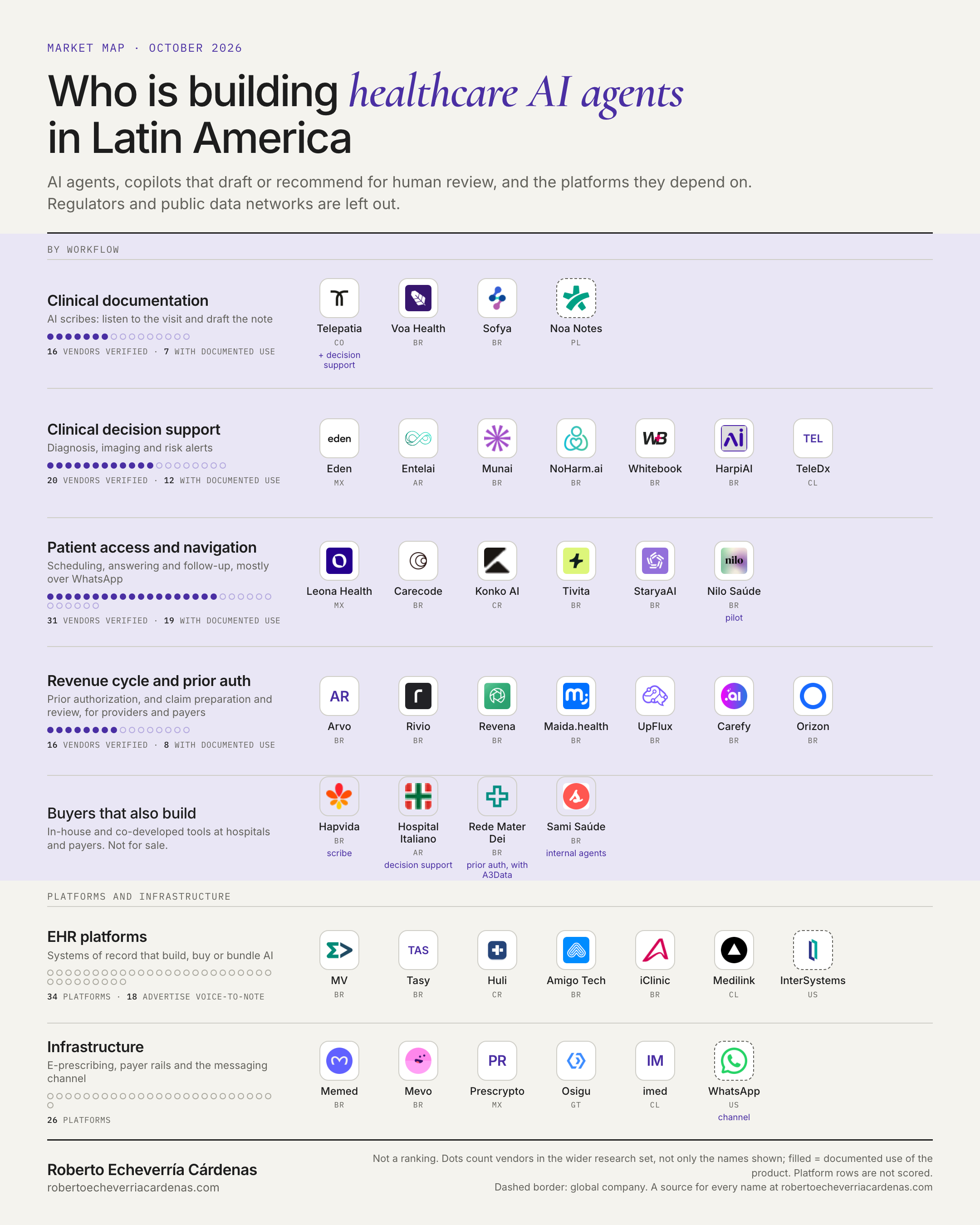
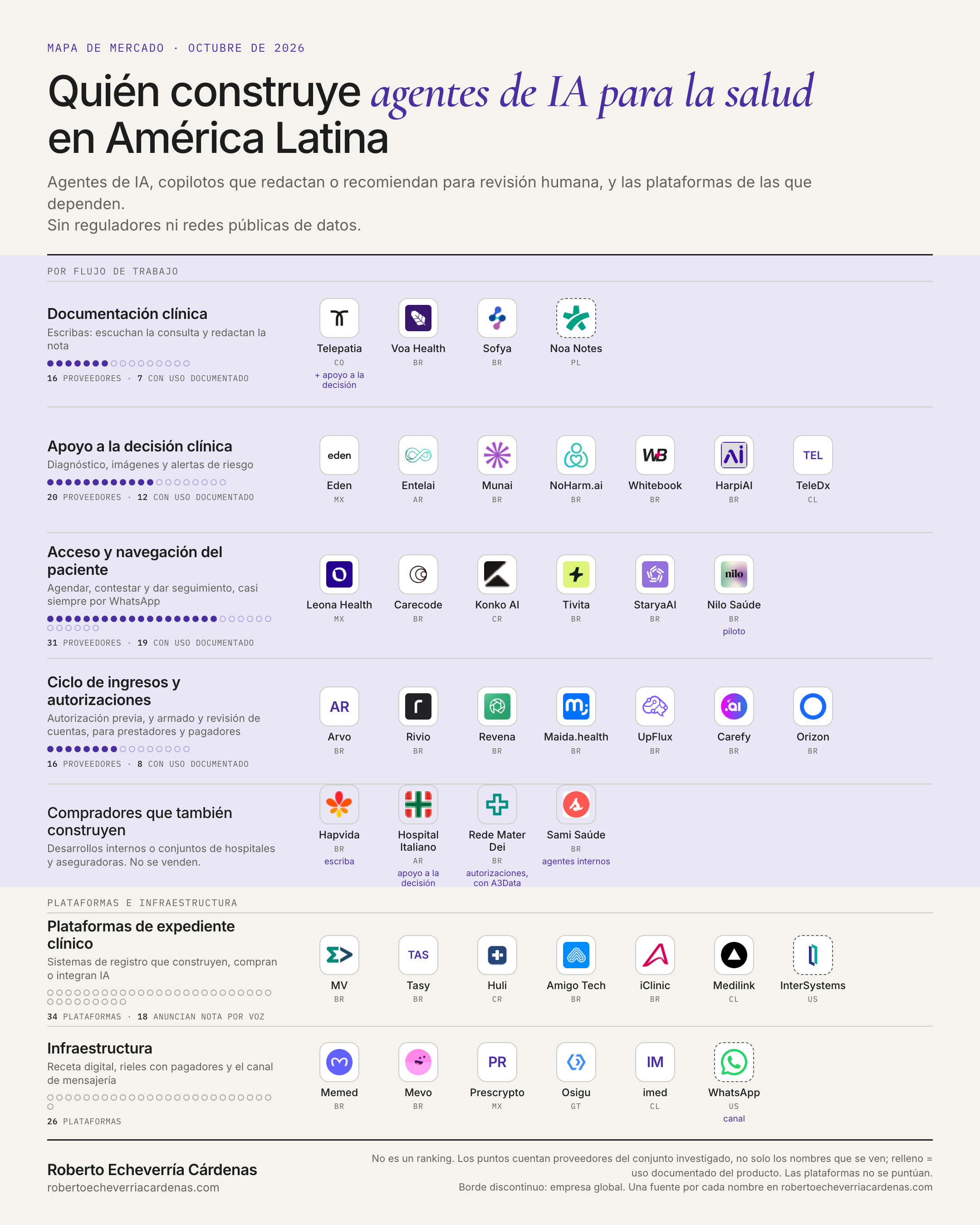
The six categories, in full
Every name links to its row in the directory, with the source. Lighter borders mark tools built or co-developed by the buyer.
Agents by workflow
Clinical documentation
AI scribes: they listen to the visit and draft the note.
Clinical decision support
Diagnosis, imaging reads and risk alerts.
Patient access and navigation
Scheduling, answering and follow-up, mostly over WhatsApp.
Revenue cycle and prior authorization
Prior authorization for care, plus claim preparation and review, for providers and payers.
Platforms and infrastructure
EHR platforms
Systems of record that build, buy or integrate AI.
Infrastructure
E-prescribing, payer rails and messaging: what agents plug into.
Born in the regionGlobal, with a product hereBuyer-built or co-developedVerified vendorWith documented use
What the map shows
One product, several workflows
Telepatia is the clearest case. Its site leads with the visit note, saved into the hospital system once the physician approves it. It also sells alerts on interactions, doses and allergies, protocol-based decision support, and an auditor that reviews every note. Carecode, which sells an AI receptionist, also markets its own EHR and scheduling suite. Andreessen Horowitz, which led its Series A, describes it as an AI-native clinical platform. I list it under documentation, the product its site leads with, and tag the rest.
A scribe on its own faces a bundling problem. No AI scribe on the map claims to work without the physician, and where the source says so, the physician reviews and signs. Meanwhile, 18 of the 34 EHR platforms I verified advertise turning the physician's voice into the note, from dictation to ambient listening. Those are vendor claims, not verified deployments, but they show what a standalone scribe is up against.
A fragmented EHR market with its own incumbents
In the US, the EHR giants set the floor: Epic, Oracle Health and athenahealth already sell their own agents. In the public sources I reviewed through October 9, 2026, I did not find a documented Epic deployment in Latin America. Microsoft's Dragon Copilot lists no country in the region.
That is not a market without incumbents. Two of them are in motion: Tasy moved this year from Philips to Brazil's Bionexo, and MV launched its own agents in May (no hospital has confirmed them independently yet). For nearly every EHR platform on the map, what is known about its AI comes from the vendor.
In decision support, six in ten vendors have documented use
12 of the 20 vendors in clinical decision support have documented use (60%), about the same share as in patient access (19 of 31, 61%). Imaging leads. Eden, from Mexico, runs radiology in the cloud and drafts part of the report. Entelai, from Argentina, sells imaging AI used at hospitals such as FLENI in Buenos Aires. HarpiAI gives second reads on X-rays across a Brazilian city's public network. TeleDx screens retinal photos for diabetic retinopathy in Chile's public network. Beyond imaging: Munai alerts care teams to clinical deterioration, and NoHarm.ai, a nonprofit, screens hospital prescriptions for pharmacists. Afya's Whitebook answers clinical questions, but I found no source documenting use of its AI assistant.
Documented use is not proven outcomes. A University of São Paulo doctoral thesis, observational and from a single hospital, found that after a sepsis alert system called Robô Laura was deployed, sepsis mortality fell from 31.4% to 21.6% in the first year, and returned to the earlier level over the next three. It also reported alert fatigue and pandemic-era changes in patient mix, so it does not establish what the software caused.
Robô Laura is in the directory, not on the one-page map. For the 41 names on the map, I then searched for published studies. About ten have one with a described method. Nearly all measure accuracy, process or usage, and most have authors from the company itself or from the hospital that built the tool. The only patient-level result I found is a conference abstract from Munai: over 90 days and 109 alerts recommending a switch from parenteral to oral antimicrobials, mean length of stay was 7.32 days when the team accepted the alert and 9.41 when it stayed pending. There is no group without the tool (both received alerts), and the abstract describes no adjustment between them. Four of its six authors are from Munai Health.
Only for TeleDx and NoHarm.ai did I find evaluations signed by third parties. TeleDx has two sets of numbers: the company's study, in the journal Eye, reports 94.6% sensitivity and 74.3% specificity across 1,123 exams, and a third-party study, in Revista Médica de Chile, found 100% and 55.4% in 371 patients at a public hospital, against a different reference standard. At a public teaching hospital in Belo Horizonte, a before-and-after study with no control group, signed by hospital and university staff, found that the share of prescriptions reviewed by pharmacists rose from 0.6% to 49% after NoHarm.ai was introduced, in a period when the hospital also enlarged its clinical pharmacy team. None establishes what effect the product had on patients.
The money
Menlo Ventures estimates USD 1.4 billion in US spending on healthcare-specific generative AI in 2025. I found no estimate for Latin America with a comparable scope and method: the two commercial reports I found (IMARC and MarketsandMarkets) measure different things, and one contradicts itself.
Public financing announcements are a more concrete record. R$ means Brazilian reais; each amount is shown in the currency the source reports. These are selected announcements from August 2025 through September 2026 for companies on the map that were born in the region, USD 6 million and up, in the currency reported. The table is not a complete record of each company's financing, and it mixes stages, instruments and business models, so the rows do not add up to capital invested in agents.
| Company | What it does (per the company) | Financing and lead | Announced |
|---|---|---|---|
| Konko AI (Costa Rica; team in New York) | Assistant that answers patients on WhatsApp and follows up until they book | USD 6M (stage not disclosed), Hi Ventures | Sep 2026 |
| Telepatia (Colombia; based in São Paulo) | Clinical AI for hospitals: documentation, decision support and note audits | USD 33M (Series A), Andreessen Horowitz | Jun 2026 |
| Memed (Brazil) | E-prescribing network | R$80M (stage not disclosed), DGF and BridgeOne | May 2026 |
| Mevo (Brazil) | E-prescribing network | R$95M (Series B extension; includes an undisclosed secondary component), Prosus | Mar 2026 |
| Revena (Brazil) | Agents that build the hospital claim | R$40M (seed), Canary | Jan 2026 |
| Rivio (Brazil) | Agents that audit the hospital claim | USD 20M (two rounds disclosed together), Monashees led one and Valor Capital the other | Dec 2025 |
| Leona Health (Mexico) | Copilot on top of the physician's WhatsApp | USD 14M (seed), Andreessen Horowitz | Dec 2025 |
| Eden (Mexico) | Cloud radiology with AI-assisted reports | USD 22M (Series A), Sierra Ventures, Liquid 2 Ventures and Daniel Servitje (sources differ on who led) | Oct 2025 |
| Arvo (Brazil) | Claims audit for health plans | R$106M (Series A), Kaszek and Base10 | Sep 2025 |
| Osigu (Guatemala; based in Miami) | Platform connecting providers and payers | USD 10M (strategic investment, part of its Series B), Eos Ventures | Aug 2025 |
| Axenya (Brazil) | Employer health with risk prediction | USD 12M (Series A), Canary and Indicator Capital | Aug 2025 |
Andreessen Horowitz is in at least three companies on the map: it led Telepatia's Series A and Leona Health's seed, and backed Carecode's USD 4.3 million pre-seed in December 2024 alongside QED. The directory also includes global vendors. Australia's Heidi Health, which has Spanish-language plans for Mexico, announced in September a USD 100 million Series C and a separate USD 240 million growth investment.
Revenue cycle: mostly Brazil, mostly the payer's side
My sample here is mostly Brazilian, and it covers two different moments: authorizing care before it happens, and auditing the claim afterward. On the payer's side, Arvo and Carefy review claims for Brazilian health plans, Orizon uses AI to decide which claims go to a human auditor (per a Databricks case study), and ADRES does it for the Colombian state. On the provider's side, Revena and Rivio build and audit the hospital's claim before it goes out, Rede Mater Dei deployed a surgical authorization agent with A3Data, and Tivita says its agent requests authorizations from health plans.
One case to read closely is Maida.health. According to the company, in the first half of 2024 its rules engine answered 95.1% of nine million authorization requests for one plan on its own: it released just over 90% at once and rejected 4.8% as mistaken requests, and the rest went to a technical team. The source does not say whether those rejections were administrative or clinical, or what review they received. For current medical uses of AI, the medical council's 2026 resolution requires human oversight, and Brazil's 2013 Medical Act reserves medical audits for physicians. Neither establishes how those 2024 rejections were handled.
What providers are fighting is the glosa, the payer's dispute of a claim. According to ANAHP's 2026 Observatory, its member hospitals in Brazil took about 77 days on average to collect in 2025, and payers initially disputed 15.9% of the amounts receivable. Initial disputes are not final losses. Those are Brazilian figures. I did not find the equivalent for Mexico or Colombia.
WhatsApp is the front door, and Meta owns it
Patient access is the most crowded workflow: 31 vendors. Several of them use WhatsApp as the patient interface. Leona Health put a copilot on top of the physician's own WhatsApp. Carecode and Konko say they serve patients there. They still have to integrate with scheduling, clinical and payment systems, so dependence on one channel is an added constraint, not a shortcut.
Meta controls the channel's access rules, its pricing and now a competing product. Since January its terms bar AI providers whose main product is the assistant itself (Meta told TechCrunch this does not reach a business that uses AI to serve its own customers, and in Brazil the competition authority kept the change suspended). In June it launched its own business agent, which books appointments, the basic task of many products in this category. And since October 1, on the WhatsApp Business Platform, it charges again for service messages beyond the first thousand a month per business number.
Colombia spelled this out in Resolution 1644: messaging apps such as WhatsApp do not meet the telemedicine-platform requirements. That provision addresses telemedicine platforms. It does not, by itself, settle the requirements for a separate scheduling workflow.
Buyers also build
The directory also includes hospitals, payers and governments deploying AI. Some report internal development, others co-development with a vendor. For a startup, the same institution can be a customer, a development partner or a competitor. Hapvida says it developed its voice system in-house and transcribed 604,383 visits with it between January and May 2026. Press coverage of Telepatia's round also names Hapvida as a Telepatia customer, and no public source says whether the two overlap. Rede Mater Dei built its agents with A3Data. Hospital Italiano de Buenos Aires and TecSalud run clinical assistants of their own.
Governments do it too. El Salvador has Doctor SV, a government app that, according to the BBC, runs on Google Cloud AI (the government reports 1.1 million downloads; the BBC could not verify them). In Costa Rica, the public health system said in May that an AI bot flags cases on the surgical waiting list that no longer need surgery, with a person validating each one before it is removed.
The rules arrived in 2026
Regulators are not on the map, but this year several rules took effect or reached their deadlines, and one more takes effect on December 1.
| Date | Country | Rule | What it requires |
|---|---|---|---|
| Apr 15 | Colombia | Resolution 1888 of 2025 | Deadline, per the Health Ministry, to join the health record interoperability network and issue the digital care summary. |
| Jul 31 | Colombia | Resolution 1644 | AI supports clinical judgment and does not replace it. Messaging apps do not meet the telemedicine-platform requirements. Providers already authorized for telemedicine have twelve months to adapt. |
| Aug 26 | Brazil | CFM Resolution 2.454/2026 | Classifies medical AI by risk, requires logging its use in the record and telling the patient. Scheduling is low risk. |
| Sep 10 | Peru | Supreme Decree 115-2025-PCM | High risk for AI that guides screening, diagnosis or prognosis. That day was the deadline on transparency and human oversight for private developers and deployers in health. |
| Dec 1 | Chile | Law 21.719 on personal data | Takes effect. The government asked for a one-year delay; as of October 2, Congress had not approved it. |
What I did not find
These are search results, not proof of an open market. A suite may have absorbed the function, or buyers may be using general-purpose software.
- Agent infrastructure. This is Scalekit's own layer. I found no company in the region selling identity or permissions for healthcare agents. The closest is Prontuário Verde, an EHR from Porto Alegre that offers an MCP server (the standard connector between agents and systems). For now the permission comes from the physician: at Memed, the physician approves the signature from a phone and chooses how long the token lasts, from one to twelve hours.
- Compliance vendors. There are rules now. I did not find a company selling compliance with them. On the US map, the governance layer lists companies. Here it would list only public agencies.
- Coding and clinical trials. I found no company dedicated to medical coding with documented use. For AI patient recruitment I found one pilot and two proposals with no documented use.
- Scribe evaluations that measure accuracy, time or outcomes. I found three published studies on AI scribes in Spanish, all from Spain. The largest was written by employees of the health system that deployed it. I found none from Latin America that measures those things. What does exist is two documents that count usage and one trial in progress. An experience report on Voa Health, published in 2025 in the Journal of Medical Artificial Intelligence, describes five months of use (2,006 registered users) and satisfaction surveys. Three of its nine authors list a Voa affiliation (two are co-founders, one a partner), and it does not measure documentation time or outcomes. A Telepatia preprint, dated May 24, 2026 and not peer reviewed, counts 52 institutions and 3,123 physicians, and states that it does not evaluate clinical effectiveness. And the SOAR randomized trial compares visits with and without Voa's scribe at the Federal University of Paraná's Hospital de Clínicas: it plans 300 visits, is still recruiting and has posted no results.
Five questions before buying an agent
- Does it act or draft? From public product descriptions, the directory labels 12 entries as taking action in another system and 36 as assistive. Those are labels for the main workflow, not verified deployments, and some companies do both.
- Which system does it write to? Ask for the name of the EHR and of a customer using it that way. A logo is not a customer.
- Who owns the patient relationship? The phone number, the messaging account and the data. Ask whether you can export the data and change vendors.
- Who signs the contract, and which budget pays? Ask for pricing, implementation cost and renewal data.
- Who signed the study, and how long did it run? Almost all the evidence I found comes from the companies themselves.
The directory
All 62 entries, each with a sentence quoted from its source in the original language, mostly Portuguese or Spanish. The summary above each quote is my English rendering. "Documented use" means a public source names a customer or a deployment using the product, or a third party reports it in use. That source can be the company's own website. It does not mean independent validation or clinical effectiveness. "No documented use" means I found no such source. In infrastructure entries, the label describes use of the platform, which may have no AI.
62 entries
Voice system that Hapvida says it developed in-house: it listens to the visit, drafts the history and suggests the ICD code; the physician validates it before the record is closed. Press reports also name Hapvida as a Telepatia customer.
“O sistema de transcrição de voz, desenvolvido internamente pela companhia, ouve a consulta em tempo real, gera a anamnese”
Doctoralia AI assistant that listens to the visit and prepares a structured summary; the physician reviews it, edits it, and copies it into the patient's record.
“Tudo o que o médico precisa fazer é copiar e colar a anotação gerada na ficha do paciente.”
AI copilot that transcribes and structures the visit; its website also lists a pre-visit agent and real-time decision support, the latter marked "coming soon." According to Convergência Digital (August 2025), Einstein uses voice recognition during visits built on Sofya and Oracle technology.
“A solução combina tecnologia da Sofya, uma startup brasileira especializada em saúde de precisão, e da Oracle.”
Clinical AI for hospitals: it listens to the visit, drafts the note and saves it to the hospital system once the physician approves; it adds clinical decision support and note audits.
“Telepatia listens to your visit and writes the clinical note as you would write it.”
Records the visit, transcribes it, and prepares the EHR entry, prescriptions, referrals, and guides with the Charcot assistant; the physician reviews, signs, and approves sending via WhatsApp. According to Bloomberg Línea (March 2025), one of its main contracts is with Faculdade Unimed, which distributes the product to regional Unimed cooperatives.
“Um dos principais contratos é com a Faculdade Unimed, o que possibilita a distribuição do produto para as regionais da Unimed espalhadas pelo país.”
AI layer for hospitals that documents care as it happens, applies the hospital's protocol on the physician's screen and reviews whether admissions are appropriate.
“A camada de IA que documenta o atendimento, aplica o protocolo do hospital na tela do médico”
Australian AI assistant for transcribing medical notes, with evidence-based answers (Heidi Evidence); it has a website, terms, and plans in Spanish for Mexico.
“La IA que transcribe tus notas médicas”
Afya's clinical decision support app for Brazilian physicians; according to its website, an AI assistant answers clinical questions, calculates doses, and reviews clinical management. Afya reports use of the app; no source was found documenting use of the AI assistant.
“Use a IA para responder dúvidas clínicas, calcular doses, revisar condutas e acelerar seus estudos.”
Cloud-based radiology operating system (PACS, teleradiology) whose AI, according to its website, drafts the impression section of the report from findings already documented.
“Impression Generation creates concise, prioritized Impression or Conclusion sections directly from documented findings.”
Argentine medical imaging AI company; according to ITSitio its technology operates at FLENI, Sírio-Libanês and Einstein. Agent One, announced to draft and validate reports, has no deployment we could confirm.
“capaz de analizar, redactar y validar informes médicos”
Imaging AI that gives the radiologist a second opinion on X-rays; the city of Volta Redonda reports more than 12,000 exams analyzed, all with human verification.
“mais de 12 mil exames já foram analisados automaticamente”
The hospital developed TANA, a generative assistant integrated into its EHR to query oncology medication cycle data in natural language, and Artemisia, which has classified breast density since 2019.
“TANA actúa como asistente clínico: permite consultar en lenguaje natural efectos adversos previos”
Platform connected to the EHR that, according to the company, alerts care teams to clinical deterioration and supports antimicrobial use. According to Jornal do Comércio (2026), Hospital de Clínicas de Passo Fundo uses it to flag sepsis risk and logged 4,692 yellow alerts in 2025.
“Já no Hospital de Clínicas de Passo Fundo, a ferramenta Munai é utilizada desde 2021 nos setores de internação.”
Connects to the hospital's EHR, evaluates prescriptions, prioritizes atypical ones, and identifies critically ill patients for review by clinical pharmacists; it is a nonprofit institute. The Federal University of Pelotas teaching hospital reports 9,484 prescriptions checked with the tool between March 2024 and August 2025.
“fruto da implantação da ferramenta de inteligência artificial (IA) NoHarm, que auxilia farmacêuticos clínicos na análise de prescrições médicas”
Cloud platform whose AI reads retinal photos to screen for diabetic retinopathy; at-risk exams go to a remote ophthalmologist. According to Pro Salud Chile (2023), the Health Ministry bought it and 170 facilities upload images.
“Hoy el Minsal tiene 170 establecimientos que están subiendo las imágenes”
The clinic uses a conversational assistant inside its EHR that lets the physician look up the patient's history; La Tercera reports a pilot with 240 specialists.
“un asistente conversacional integrado en la ficha clínica electrónica de cada paciente, que permite al doctor chatear con la base de datos”
ISSSTE launched four AI mammography reading centers in June 2026, where radiologists remotely interpret images sent from its facilities.
“Esta semana, comenzaron a funcionar cuatro grandes centros de interpretación de mastografías con la utilización de IA en hospitales del ISSSTE”
Laura
Platform that analyzes patient data in real time and alerts care teams to clinical deterioration and sepsis; the company says it warns from 10 hours to 3 days in advance.
“identifica sinais de alerta e comunica às equipes assistenciais de 10 horas até 3 dias de antecedência sobre o risco clínico”
Linda
Device that captures infrared images of the breast and analyzes them with AI to flag possible signs of cancer, as a complement to mammography, according to Startups; it does not give a final diagnosis.
“capta imagens infravermelhas da mama e as analisa por meio de inteligência artificial”
Tele-mammography diagnosis network; according to the company, an AI algorithm flags suspicious findings for the radiologist to review and confirm.
“La IA permite acelerar los procesos del radiólogo que analiza una mamografía.”
Reads retinal photos with AI to flag signs of diabetic retinopathy and other eye disease and returns recommendations, according to the company; Contxto named Devlin as a customer in 2022.
“The company is working in Mexico with companies such as Devlin (an optical eyewear company)”
Conversational interface on TECgpt that summarizes the patient's clinical history for the physician; TecSalud says more than 3,800 physicians cut their searches from minutes to seconds.
“A través de una interfaz conversacional impulsada por TECgpt, permite a los médicos acceder de forma inmediata a información clínica clave”
AI agents that serve clinic patients over WhatsApp, Instagram and phone, schedule, cancel and reschedule appointments and handle collections, according to the company; its site also markets its own EHR and scheduling suite.
“IA que atende seus pacientes 24h pelo WhatsApp, telefone e Instagram. Agenda, confirma e reagenda sozinha.”
Kora, an AI assistant that, the company says, answers clinic patients on WhatsApp around the clock and follows up until it secures an appointment.
“Kora contesta al instante, 24/7 y hace seguimiento hasta lograr una cita.”
App that connects to the physician's WhatsApp Business account to prioritize messages, suggest replies, and transcribe voice messages; the website says it also schedules appointments.
“Vincula tu cuenta de WhatsApp Business con Leona de forma segura a través del proceso oficial de Meta.”
AI agents: Clara triages and schedules, Amanda helps book appointments in external scheduling systems (Wise, Tasy, MV), Roberto handles care plan reminders, and Cláudio checks surgical preparation.
“Uma agente receptiva que ajuda pacientes a marcar consultas médicas em agendas externas à Nilo (Wise, Tasy, MV, agenda própria etc)”
Digital health plan whose employees built hundreds of internal AI agents that automate tasks, support clinical decisions, and reduce operational workload, according to Época Negócios (July 2026).
“São centenas deles espalhados pela empresa, automatizando tarefas, apoiando decisões clínicas e reduzindo atividades operacionais.”
StaryaAI
Júlia, a voice agent in the call center of 18 Unimed Paraná cooperatives, runs service flows with no human involved; the company says it resolved 12% of calls on its own.
“a assistente virtual é uma agente de voz com fala natural e capacidade resolutiva, capaz de conduzir diversos fluxos de atendimento de forma autônoma”
Clinic management platform with agents: Júlia serves patients over WhatsApp and helps schedule, Tais requests prior authorizations from health plans, and Tom drafts the EHR. According to Exame (September 2026), the company reports more than a thousand clients and says its agents already account for about 30% of recurring revenue; the article names no clients.
“Juntos, esses agentes digitais já respondem por cerca de 30% do faturamento recorrente da Tivita”
The company says an AI engine anticipates risks and suggests interventions, and that nurses guide care over WhatsApp, including chronic patient management, for employers.
“IA identifica riscos, enfermeiros guiam o cuidado via WhatsApp”
Cari AI presents as a case study the bot Ana María of EPS Sanitas, which handles requests on WhatsApp to schedule, check, cancel, and reschedule appointments; it now adds phone and video calls.
“Su función inicial fue atender solicitudes de agendamiento, consulta, cancelación y reprogramación de citas médicas”
CCSS (Costa Rica's public health system) says an AI bot cross-references EDUS and the Civil Registry to detect unresolvable cases on waiting lists; a person validates each case.
“Por medio de un bot, la herramienta automatiza la identificación y clasificación de casos no resolutivos dentro de la lista de espera quirúrgica”
Salvadoran government app with Google Cloud AI that manages appointments and suggests diagnoses, treatments, and lab tests; in April 2026 it announced a phase for chronic patients.
“una app que opera con tecnología de inteligencia artificial de Google Cloud y que gestiona citas, sugiere diagnósticos, tratamientos y pruebas de laboratorio”
Clinic network whose AI agent contacts patients with abnormal glycated hemoglobin to invite them into its diabetes care pathway; other agents recommend opening or closing schedules.
“Um agente identifica tanto o resultado alterado quanto o paciente e inicia o contato”
On the payer side: AI agents that review health plans' medical claims to flag improper payments; the company says it has more than 70 agents, connected to the health plan's ERP.
“+70 Smart Agents especializados, cada um focado em um tipo de irregularidade.”
On the payer side: AI agents for health plans that analyze prior authorizations, hospital admissions, and medical claims; the authorization agent suggests approving or denying. The page mentions automating high-confidence decisions.
“Analisa pedidos, anexos, contexto e histórico para dar sugestão de aprovação ou negativa em segundos.”
On the payer side: AI rules engine that, according to the company, automated 95.1% of responses to 9 million requests at one plan the source does not name (first half of 2024); 4.9% went to specialists.
“garantiu a automação de 95,1% das respostas a pedidos de exames, consultas, internações e outros procedimentos”
Brazilian intermediary between health plans and providers. A Databricks case study says its AI decides whether a claim goes to human audit or is approved automatically.
“This agentic AI solution classifies whether a medical claim needs to be referred for human audit or can be automatically approved”
On the provider side: hospital network that deployed three AI agents with A3Data, one for surgical prior authorizations; A3Data reports 66% less average authorization time at one unit.
“Os resultados positivos levaram à implantação de uma terceira solução, nomeada Agentes de Autorização.”
Says its AI reads contracts with payers and clinical data, builds the supported claim, and enters the validated items into the hospital information system (HIS).
“Inteligência artificial Revena aprende com seus contratos comerciais, relaciona com os dados clínicos e edita itens direto no seu HIS.”
AI agents that connect to hospital systems, audit claims, apply payer rules, recommend corrections, and, according to the company, automate stages of billing. Its website presents named cases: Sírio-Libanês, A.C.Camargo and Einstein.
“O Einstein utiliza a Rivio para focar no cuidado, com a receita garantida.”
Says its AI agents audit 100% of health plans' medical claims, release the low-risk ones, and send the rest to a human auditor.
“A UpFlux analisa 100% das contas, não a amostra, e identifica pagamentos indevidos, glosas e fraudes”
The state as public payer: in July 2026 it put into operation an AI platform that analyzes medical claims from traffic accidents without SOAT, with professional auditors supervising.
“acaba de poner en operación la nueva plataforma de procesamiento y análisis automático de cuentas médicas”
The state as public insurer: says it has used an AI model since 2023 that helps review whether Ley de Urgencia (Emergency Law) cases meet the requirements for payment.
“basada en ciencia de datos e inteligencia artificial que ayuda a revisar los casos ingresados a FONASA asociados a la Ley de Urgencia”
Scheduling, EHR, and e-prescription platform for physicians; its AI, Amigo Intelligence, with Google Cloud, says it automates patient history taking, analyzes tests, and offers a clinical chat.
“a automação da anamnese clínica, que reduz o tempo de preenchimento e análise de informações médicas”
Practice management and EHR software for physician offices, with AI Clinical Notes that, according to the company, listens to the visit and pre-fills the EHR with the physician's sign-off. According to El Financiero (November 2025), Huli reports more than 1,500 physicians using it.
“La nueva opción ya es utilizada por más de 1.500 médicos, según Huli”
Cloud EHR with AI that transcribes the visit in real time and generates a clinical draft that the physician reviews and validates.
“A IA gera um rascunho clínico estruturado”
TrakCare EHR with IntelliCare, an AI layer with natural-language commands, record summaries, and assisted documentation; RedSalud (Chile), a TrakCare user since 2019, announced it will add it.
“RedSalud profundizará su proceso de transformación digital con la incorporación de InterSystems IntelliCare”
EHR and management software for health centers; its Medilink IA suite says it offers voice clinical notes, clinical summaries, and a WhatsApp and phone assistant that books appointments.
“Medilink IA es una suite de 5 herramientas de inteligencia artificial diseñadas específicamente para centros de salud.”
Hospital information system (HIS) and EHR that launched Soul Agents in May 2026; MV says its agents carry out scheduling, pharmacy review, and audits of claims and glosas (a payer's denial or objection to a claim) with human oversight.
“O Soul Agents é uma camada cognitiva que compõe o Ecossistema MV para transformar comandos em execução, automatizar jornadas e reduzir a operação manual.”
Tasy EHR, sold by Philips to Bionexo (signed in December 2025, closed in April 2026); its AI assistant was announced in 2024 and no customer is named.
“A Bionexo concluiu a aquisição do Tasy, software de gestão em saúde e prontuário eletrônico anteriormente pertencente à Philips, em uma operação de €161 milhões.”
Hospital operating system with AI for Latin America: hospital management (Vie), analytics (Pulse), AI medical imaging (Indira), and digital pathology (Coral); it cites Hospital CIMA in Costa Rica.
“A single platform to eliminate silos, automate administrative burden, and orchestrate clinical, operational, and financial resources in real time”
ERP and hospital management software for hospitals and health plans; it says it has AI modules (UpFlux, Horuss) and the LYNN model, launched in February 2026, with initial agents for financial processes.
“um sistema de gestão e avaliação da jornada do paciente, equipado com tecnologia de Inteligência Artificial”
Chilean operator that connects clinics with Fonasa, isapres (private health insurers), and insurers to price and authorize copayments online (bono electrónico); it also processes medical leave and e-prescriptions. Fonasa names it as one of the two systems for buying the electronic voucher at the provider. It does not say it uses AI.
“A través del sistema Imed y/o Medipass, se realiza la compra con la huella dactilar o validación de Cédula de Identidad, respectivamente.”
Digital prescribing network that says it connects to all hospital management systems and gives software partners an integration API with production keys. According to Baguete (2021), the insurer SulAmérica and its Docway platform adopted it for telemedicine prescriptions.
“adotaram a solução da Memed, healthtech especializada em receitas médicas digitais”
Digital prescribing network, formerly Nexodata, that according to Brazil Journal is in about 1,100 hospital units, including Rede D'Or and Sírio-Libanês, and says it has 100,000 active physicians.
“A empresa está presente em cerca de 1.100 unidades hospitalares de nomes como Rede D’Or, Hospital Sírio-Libanês e Beneficência Portuguesa.”
Cloud platform that connects providers and insurers across Latin America for eligibility, prior authorizations, and claims; it says it uses AI and RPA in steps of the revenue cycle. According to Refresh Miami (2024), the company reports 1.5 million transactions in 2023 and more than 65 institutional clients, which the article does not name.
“Processing 1.5 million transactions last year, Osigu is transforming health revenue cycle management in LatAm”
Mexican e-prescription platform that developed RexChain, an open digital prescription platform that UNICEF Venture Fund says about 35,000 physicians in Mexico use.
“RexChain, developed by Prescrypto, was created to address the urgent need for electronic prescription infrastructure in Mexico.”
Messaging channel through which, according to Memed, physicians send digital prescriptions to patients at no additional cost, and through which Farmacias del Ahorro managed medical visits.
“O WhatsApp Business, que antes era um plano pago, foi incorporado ao nosso plano padrão”
Validates and audits outpatient drug dispensing at pharmacies for obras sociales and prepagas (Argentine social and prepaid health plans). It is infrastructure only, with no declared AI; its WhatsApp Smartbot answers pharmacies' questions.
“administración y auditoría de la dispensación de medicamentos ambulatorios en las farmacias”
Brazilian patient journey platform with an API platform (MyConnect) that integrates hospital systems, and six AI agents; it says it has more than 290 APIs and 900 connected units.
“A Nuria desenvolveu uma plataforma de API que promove a interoperabilidade dos principais players do setor”
Argentine platform where providers check eligibility and validate and authorize services online with obras sociales and prepagas. Connectivity infrastructure; it does not say it uses AI.
“Nuestra solución permite realizar la elegibilidad, validación, registración y autorización de todas las prestaciones de manera online.”
How it was made and what it is not
This is an editorial market map based on public sources reviewed through October 9, 2026. It is not a census or a ranking. AI tools assisted discovery, source checking and relevance screening. I made the final decisions on inclusion and classification, and the errors are mine.
- Procedure. A first pass produced 260 candidate records under one rule: nothing gets in without a page anyone can open. A second pass, run separately, reopened every source: it removed 15 records and corrected 183. After duplicates and announced-only agents were set aside, 210 remained. Established platforms stay even when their AI is only announced, and the directory marks them that way. Regulators and public networks then came out, and a relevance screen, a review by a second AI system and comments from early readers cut the list to the 62 shown.
- Counts. The dots count vendors in the wider research set, 143 in all, not only the 62 entries in the directory. Another 21 projects run by hospitals, payers and governments are counted separately. Documented use means a public source names a customer or a deployment using the specific product, or a third party reports it in use: a launch announcement or a platform's existing customer base does not qualify. The counts describe what I could verify, not market size or the total number of competitors. 33 of the 62 entries are Brazilian, which describes my sample as much as the market.
- What gets in. Companies born or based in the region whose product does work in a healthcare workflow, the platforms those products depend on, and in-house builds by hospitals, payers and governments. Global companies get in only when there is a source for their product in the region (4 did). The 58 regional entries come from 8 countries.
- Figures. Customer counts, volumes and results are company statements and are attributed as such. So are regulatory clearances. Where sources disagree, the entry says so.
- Country. Each company is listed under the country where it was born or, when that is not on record, where it launched. The entry gives the headquarters when it differs.
This map is not a recommendation to buy or to invest. No company paid to appear or saw its entry before publication. If a company is missing, or a fact is wrong, email me with the source. Corrections are free of charge.
Disclosure. I am an advisor to Konko AI, and a client of my agency, Flow Results, appears on Konko's website as a Konko customer. I co-founded Costa Rica's medical marketing congress together with Huli and have spoken at Huli events.
Update, October 12, 2026. A reader asked whether the 41 names on the one-page map have published outcome studies. I searched again, name by name, and corrected three things. The item on scribe evaluations said I had found none from Latin America: a Voa Health report and a Telepatia preprint exist, and both count usage. I added what has been published on Munai, TeleDx and NoHarm.ai. And Afya Whitebook moved to "no documented use", because its source names no customer, date or usage figure for its AI: decision support now stands at 12 of 20 vendors with documented use, not 13. I also re-checked the source cited in every documented-use entry on the one-page map and replaced it in ten, with one that names a customer or reports the use: Munai, Sofya, Voa Health, NoHarm.ai, Rivio, Tivita, Huli, imed, Memed and Osigu. And I settled on a single definition of documented use, which had appeared in two wordings.
The next revision is due in January.